
Learning how to play guitar is one of the most rewarding journeys you can start. But if you’ve been looking online for tutorials, you’ve probably noticed another pattern. The pattern of overwhelming technical jargon, strict finger exercises, and rigid practice routines. Sounds familiar?
While that works for some people, it doesn't fully reflect how most of people actually experience music in their lives. At Northlight Music Collective, we believe learning guitar should feel alive, not like homework. Instead of memorizing boring music theory before you even play a sound, we focus on real-world skills that get you playing songs right away.
The Secret to Quick Success: What Are Chords?
When learning how to play guitar, first before diving into specific shapes, it helps to understand what a chord actually is. A chord is simply playing multiple notes together at the exact same time to create a harmony. Think of notes like individual letters, and chords like complete words. By learning just a few basic "words," you can start putting them together to tell a story and play hundreds of different songs.
Many traditional classes put kids in isolation, where they practice scales alone in a room just to please a teacher or pass a formal test. We think that kills the joy of making music before it even begins. That's why we prefer real-world skills over formal testing. As we mentioned in our core philosophy, we don't need your exams. We want you to gain experience through playing shapes that let you jam with other people immediately.
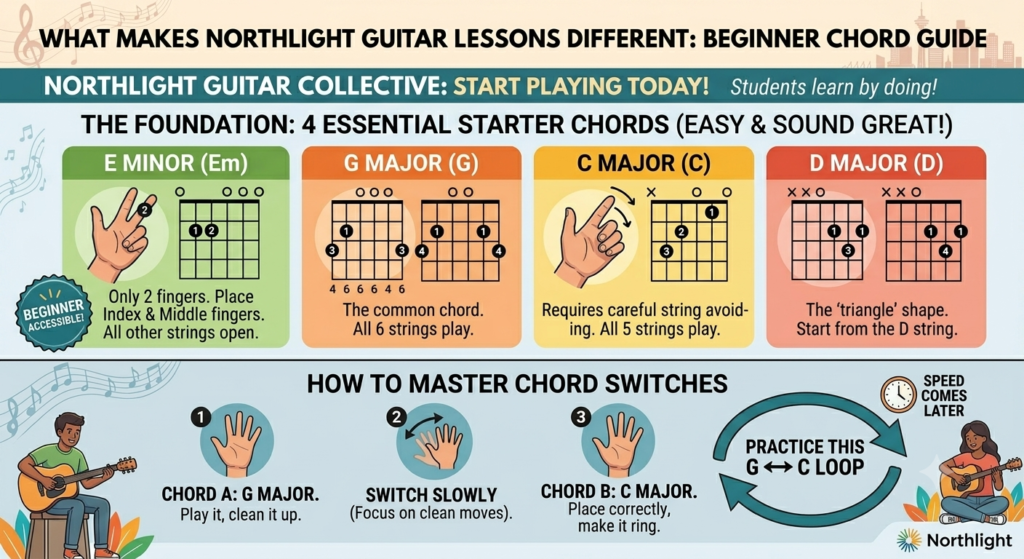
Your First Two Chords: Em and Cadd9
If you want to start learning to play guitar and play really fast, you don’t need to learn dozens of difficult shapes all at once. You only need two simple, open chords that sound great together:
E Minor (Em): A deep, slightly melancholic chord that forms the backbone of many rock and pop songs.
C Added 9 (Cadd9): A beautiful, modern-sounding variation of the traditional C major chord that is much easier on your fingers.
The best part of it is that these shapes share common finger placements, which means your hand doesn't have to jump all over the fretboard. This naturally encourage exploring of smooth transitions. It also helps build confidence quickly without the frustration of completely changing your hand shape every time.
Step-by-Step: How to Play E Minor (Em)
The E Minor chord is the perfect starting point because it only requires two fingers. Here is how you do it:
- Place your middle finger on the 2nd fret of the 5th string (the A string).
- Place your ring finger on the 2nd fret of the 4th string (the D string).
- Make sure your fingers are curled so they don't accidentally touch the other strings.
- Strum all six strings together from top to bottom.
Listen to the sound. It should be full and clear. When you just started getting used when learning how to play guitar it might sounds a bit buzzy or dead. Just press down just a little bit harder right behind the fret wire, not directly on top of it. It might be hard at first. When you learning how to play on the instrument, it's normal! Don't worry if your fingertips feel a little tender at first - that's completely normal when you are starting out. You will build up calluses in no time!
Step-by-Step: How to Play Cadd9
Once you feel comfortable with Em, moving to Cadd9 is incredibly easy because your shape stays very similar:
- Keep your middle finger on the 2nd fret, but move it up to the 4th string.
- Place your index finger on the 2nd fret of the 5th string.
- Place your ring finger on the 3rd fret of the 2nd string.
- Place your pinky finger on the 3rd fret of the 1st string.
- Strum the bottom five strings, leaving the thickest top string quiet.
This chord has a beautiful, rich ringing quality to it. When learning how to play guitar it's important to practice moving back and forth between Em and Cadd9. Don't worry about speed right now. For now, just focus on getting your fingers to find their places. The muscle memory will come naturally the more you do it.
The Power of 15 Minutes a Day
A common myth is that you need to practice for hours every day to get good when learning how to play guitar. This is especially true in traditional academic settings that demand long-term commitments. But considering today's pafe of information and busy schedules, that's not realistic for most youth.
Consistency is way more important than long hours. To learn to play an instruments, start with just 15 minutes of focused practice a day. By simply switching between these two shapes while watching your favorite show or hanging out - will do wonders. Before you know it, your fingers will move to the right frets automatically without you even looking down at your hands.
Learning in a Creative Ecosystem
Learning it is a long journey and mastery might take years. Sometimes it might be discouraging. That's why it's important to not going this journey alone! We are welcoming you to try the same lessons, but under our direct guidance! We have all the equipement, read more to know about our studios and what we've built for our students! Our students not just attending classes – they are also a part of a creative ecosystem where they collaborate with other students across different skill levels.
Once you know how to strum a couple of chords, we don't leave you sitting by yourself. We get you playing in bands, performing it in our rehearsal studio, and collaborating with students who are learning drums or music production. This is especially important for youth who may not thrive in traditional academic settings but come alive through music. You can learn more about our unique community environment on our article: Music Schools in Vancouver: Why We Are Different.
Accessible Music Education in Vancouver
Because as we know that many music schools in Vancouver are expensive - it's limiting access for young creators. Buying a brand new guitar and paying for private lessons can cost hundreds of dollars before you even know if you like the instrument.
While our approach might sound too good to be truth, we in Northlight Music Collective operate as a non-profit, donation-based model school. This allows us to:
- Reduce financial barriers
- Offer free or low-cost programs
- Provide instrument access through our lending library
For beginners, especially who just started learning how to play guitar, this is huge - having access to the instrument and to place to learn it, for free. You don't need to buy gear to start. Our lending library ensures you can take a guitar home to practice without financial stress hanging over your family. If you are also interested in how to record your guitar tracks and make your own beats, check out our Free Music Production Classes.
Take the First Step
Before the final decision, when you're comparing music schools in Vancouver, it’s worth asking: do you want structured, rigid instruction, or a creative environment that mirrors real music culture? What lights you up when you are thinking about this musical journey?
At Northlight Music Collective, we’re building something meaningful, something that prioritizes, creativity and community over rigid systems, and provides access and necessary instruments for that.
If that resonates, we’d love to have you involved. Visit our Contact Us to join an introductory session on how to learn to play guitar effectively. Or if you want to learn how you can support our programs through volunteering and donations!